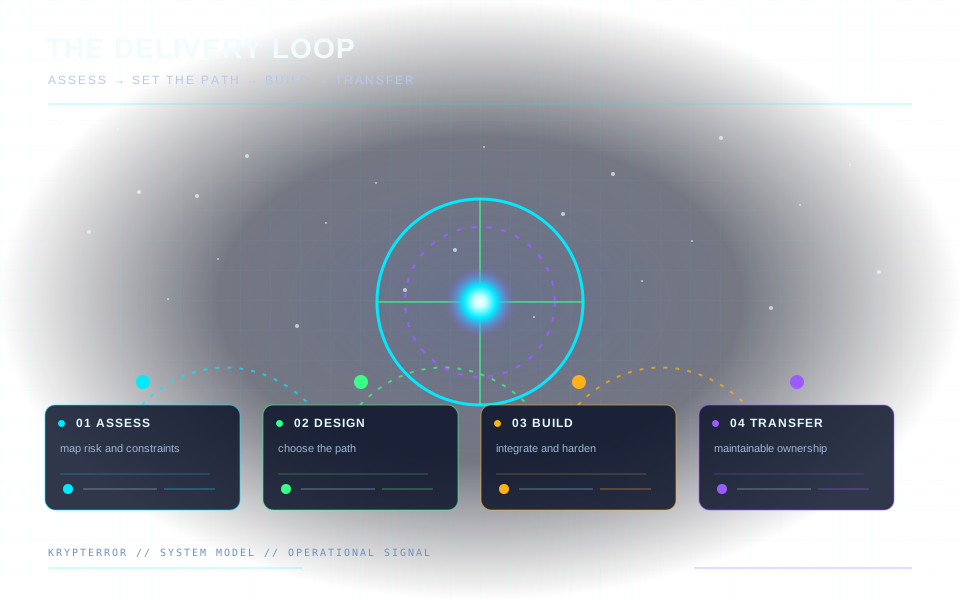
1. Assess the system you have
We map the product, dependencies, operational workflow, security exposure, and business constraints affecting the work. The result is a concrete understanding of where risk, cost, and fragility are accumulating.
2. Set a pragmatic path
We define the smallest responsible sequence of changes. You receive clear trade-offs, ownership boundaries, and a plan that fits real usage rather than speculative scale.
3. Build and harden
We implement, integrate, test, document, and deploy. The deliverable is a working system, not a report that leaves your team to fill in the difficult parts.
4. Transfer and partner
We document the system and transfer knowledge so you are not dependent on a black box. Where continuous senior engineering capacity helps, we remain available as an ongoing partner.
Engagements
Typical work starts with a paid technical assessment, followed by a defined implementation or an ongoing engineering partnership. Final scope, responsibilities, and commercial terms are agreed in writing before work begins.
Which process should stop depending on somebody remembering it?
Talk to us about automation